Unit Economics
& Pricing
If you are building an AI product, every user interaction costs you real money. This changes everything about how you set prices — and it is the thing most AI founders learn too late.
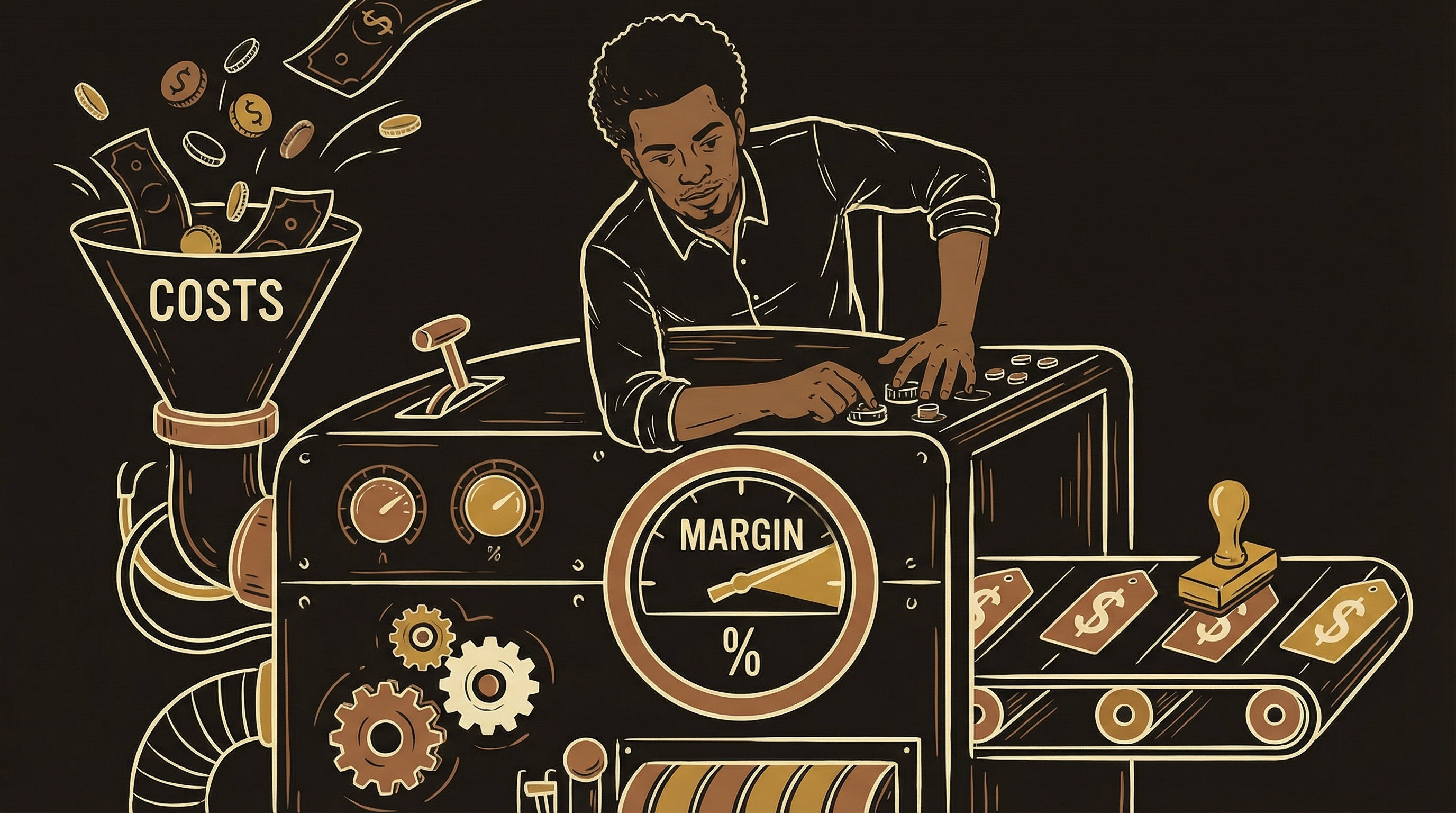
Traditional SaaS is a movie theater. One projector serves everyone — whether 10 people or 300 are in the seats, your costs barely change. AI software is a restaurant. Every plate requires fresh ingredients. Every cocktail costs you liquor. The more customers you serve, the more you spend. You need to know your food cost before you price the menu.
Why This Matters More for AI Products
In traditional SaaS, your marginal cost per user is effectively zero. One more user on your project management tool costs fractions of a penny in server time. This is why SaaS companies can offer unlimited plans and scale to millions without worrying about per-user costs.
AI products are fundamentally different. Every interaction has a real, measurable cost: the LLM processes tokens, the voice API converts speech, the image model renders pixels. A voice-heavy AI product can spend $0.08-0.12 per minute of usage. At 100 minutes per subscriber per month, that is $8-12 in variable costs before you pay for anything else — hosting, databases, your time.
The counterintuitive result: your best customers — the ones who use your product the most — can be your most expensive. In traditional SaaS, heavy users are free. In AI products, heavy users cost you real money. A subscriber who uses 200 minutes a month costs you twice as much as one who uses 100 — but they both pay the same subscription fee.
This is why you must understand unit economics before you set prices. Getting this wrong does not just mean thin margins — it means every new user makes you poorer. The faster you grow, the faster you lose money. That is the opposite of how a business should work.

Know Your Cost Per Unit
Define your unit. Add up every service that gets called during it. This is the most important number in your business.
Before you can price anything, you need to answer: "What is one unit of my product, and what does it cost me to deliver?" A unit is whatever your user consumes — one minute of AI conversation, one generated image, one report, one analysis. Define the unit, then add up every service that gets called during it.
Voice AI Product
Unit = 1 minute of conversation
At 100 min/mo: ~$10.50 variable cost per subscriber
Text AI Product
Unit = 1 AI response
At 200 responses/mo: ~$6.60 variable cost per subscriber
Image Generation Product
Unit = 1 generated image
At 100 images/mo: ~$5.30 variable cost per subscriber
These numbers are illustrative — your costs depend on providers, models, and usage patterns. The exercise is what matters: calculate your real cost per unit.
Fixed vs Variable Costs — Your Rent vs Your Ingredients
Understanding the difference changes how you think about growth.
Fixed Costs (Your "Rent")
Stay the same whether you have 1 user or 10,000. Database hosting (~$25/mo), website builder (~$30/mo), app developer accounts ($100-200/yr), domain name, error tracking service, build service for mobile apps. You pay these regardless of revenue. Total for a typical solo product: $100-200/month.
Variable Costs (Your "Ingredients")
Grow with every user interaction. AI API calls per session, voice processing per minute, image generation per request, payment processing per transaction (Stripe takes ~2.9% + $0.30). More users = more cost. This is the number that determines whether your unit economics work or slowly kill you.
MONTHLY FIXED COSTS
Database hosting               $25
Website / marketing site       $30
Error tracking (Sentry)        $0  (free tier)
Mobile build service           $30
Domain + email                 $15
Analytics (Mixpanel)           $0  (free tier)
TOTAL FIXED                    $100/month

VARIABLE COSTS PER SUBSCRIBER (estimated usage: 80 units/mo)
AI API calls (80 x $0.10)      $8.00
Payment processing (2.9%)      $0.72  (on a $24.99 plan)
TOTAL VARIABLE PER SUB         $8.72/month

REVENUE PER SUBSCRIBER
Subscription price             $24.99
Minus variable costs           -$8.72
GROSS MARGIN PER SUB           $16.27  (65%)

BREAK-EVEN
Fixed costs / gross margin per sub
$100 / $16.27 = 7 subscribers to cover fixed costs
Real break-even (with your time): ~100-150 subscribers
The math break-even is low — about 7 subscribers to cover fixed infrastructure costs. But real break-even includes your time, opportunity cost, and the buffer for months where usage spikes. A more realistic target: 100-150 paying subscribers before the business sustains itself. That is your north star number. Print it out. Tape it to your monitor.
The Dormant Subscriber Problem (That Is Actually an Advantage)
Most subscription businesses depend on people who pay but do not use the product. AI products cannot.
The gym model: 80% of gym members pay their monthly fee but rarely show up. The gym's business depends on this — if every member showed up every day, the gym would be overcrowded and the economics would collapse. Most SaaS products work the same way. A significant portion of subscribers pay monthly but use the product occasionally or not at all. This is called dormant subscriber revenue, and traditional SaaS businesses build their models around it.
AI products are different — but in a way that is actually healthier. Because every interaction costs money, you want dormant subscribers — they pay without incurring variable costs. But you cannot depend on them. If your pricing only works when most users are dormant, you have a fragile business that breaks the moment users actually engage with your product.
The right approach: price your product assuming every subscriber is active. If your economics work when everyone uses the product, then dormant subscribers become pure upside — extra margin you did not plan for. If your economics only work when most subscribers are dormant, you have a ticking time bomb.
Pricing Strategy — Five Principles for AI Products
These protect your margins while keeping users happy.
Tiered Plans With Usage Allocations
Free (try it), mid-range (regular use), premium (heavy use). Each tier includes a usage allocation — not unlimited. Frame limits positively: "120 sessions a month" not "limited to 120." The free tier should demonstrate value clearly but be short enough that serious users upgrade within a week. The premium tier should cover 90% of power users without you losing money on any of them.
Price for Active Users, Not Average Users
If your average subscriber uses 60 units/month but your most active users use 200, do not price based on the average. Price so that even the heaviest user on each tier is profitable. The average will take care of itself — most users use less than the allocation. But the user who maxes out should not cost you money.
Web vs App Store Pricing
Apple takes 15-30% of in-app purchases. Google takes 15-30%. If you sell a $24.99 monthly plan through the App Store, Apple keeps $3.75-7.50. Route annual plans and high-value purchases to your website where you keep 97% (Stripe takes ~3%). Recent court rulings allow you to tell users about cheaper web pricing.
Annual Plans
15-30% discount vs monthly. Annual subscribers churn 3-5x less than monthly subscribers. You get cash upfront — 12 months of revenue on day 1 instead of hoping they stay for 12 months. Offer exclusively on your website where you avoid the Apple/Google cut entirely. This is the single highest-leverage pricing decision.
Never Offer Unlimited
Unlimited usage on an AI product is a promise you cannot keep without losing money. Your most engaged users — the ones who love your product — will cost you the most. Cap usage at levels that keep every user profitable, and frame the caps as a feature: "focused practice, not endless scrolling."
Never offer unlimited usage on an AI product. Your marginal cost is real. One heavy user on an unlimited plan can cost you more than they pay — and your most engaged, most loyal users are the heaviest users. Unlimited rewards them by punishing you.
The Apple/Google Tax — Understanding Platform Fees
This is the biggest hidden cost most AI founders do not account for until it is too late.
| Channel | Revenue You Keep | Fee | On a $24.99 Plan | Best For |
|---|---|---|---|---|
| Your Website (Stripe) | ~97% | ~3% + $0.30 | You keep $24.00 | Annual plans, high-value purchases, power users |
| App Store (Apple IAP) | 70-85% | 15-30% | You keep $17.50-$21.25 | Monthly convenience, discovery-driven users |
| Google Play | 70-85% | 15-30% | You keep $17.50-$21.25 | Android users, emerging markets |
On a $24.99 plan with $8.72 in variable costs: through your website you keep $24.00, leaving $15.28 gross margin (61%). Through Apple at the 15% rate you keep $21.25, leaving $12.53 gross margin (50%). Through Apple at the 30% rate you keep $17.50, leaving $8.78 gross margin (35%). That 35% is dangerously thin for an AI product.
This is why annual plans belong on your website. A $199/year annual plan through Stripe nets you ~$193 (97%). Through Apple at 30%, you net ~$139. The $54 difference across 100 annual subscribers is $5,400 per year — real money for a solo founder.
Framing Limits Positively — Pricing Psychology
The same cap feels like a restriction or a feature depending on how you present it.
How NOT to Frame It
"Limited to 120 sessions per month." "Maximum 100 images." "Capped at 60 minutes." These feel restrictive. Users focus on what they cannot do. The word "limited" triggers loss aversion — the feeling of losing something they might want.
How to Frame It
"120 sessions a month — that is 4 sessions a day, every day." "100 images — enough for 3 a day, every day." Frame the allocation in daily terms so users see how generous it actually is. Most users will never come close to the cap. But they feel abundant instead of restricted.
Never show raw usage counters. "You have used 47 of 120 sessions" creates anxiety. Instead, show progress in positive terms: "You have practiced 47 times this month" without mentioning the cap. Only surface the limit when they approach it — at 90%, show a gentle nudge toward the next tier. The cap is a business necessity. The user experience should make it feel invisible.
When to Raise Prices
You will almost certainly underprice at launch. Here is how to know when — and how — to fix it.
Most solo founders underprice. It feels safer — lower prices mean less friction, more signups, less pressure to deliver. But underpricing is the most common way AI startups die. You grow users, your costs grow linearly, your revenue does not cover the costs, and you run out of money while looking successful.
Raise prices when: your gross margin per subscriber is below 50%. When more than 20% of users hit their usage cap regularly (the cap is too generous, not the price too high). When you add significant new features or capabilities. When you move from beta/early access to full launch — your early adopters got a deal; new users pay the real price.
How to raise prices: grandfather existing subscribers at their current rate for 3-6 months. Announce the increase 30 days before it takes effect. Explain what has improved since they signed up. Offer annual plans at the old rate as a one-time conversion offer. Most users accept price increases if they feel the value has increased proportionally.
The test: if you raise prices by 20% and lose fewer than 5% of subscribers, you were underpriced. If you raise prices by 20% and lose 20% of subscribers, you were priced correctly and the increase was too aggressive. The sweet spot is a price increase that loses almost nobody — because it reveals how much headroom you had.
Margins Improve With Scale — But Not Automatically
Fixed costs spread. Variable costs stay constant per unit. But volume unlocks new pricing tiers from providers.
At 10 users, $150/month in fixed costs is $15 per user. At 1,000 users, it is $0.15 per user. Variable costs stay constant per unit — but at higher volumes, you unlock provider discounts. AI providers offer enterprise tiers with 30-50% lower per-token costs at volume commitments. Voice API providers offer committed-use discounts. Even Stripe offers custom pricing at scale. These volume discounts are the profitability milestone — the moment your cost per unit drops meaningfully and your margin jumps.
How to Analyze Competitor Pricing
Look at competitors not to copy their prices but to understand the market's expectation. Find 3-5 products in your space. For each one, note: their price, what is included at each tier, whether they cap usage or offer unlimited, and whether they charge through the app store or their website.
Most competitors in the AI space are underpricing — they are either VC-subsidized (burning money to acquire users, planning to raise prices later) or they have not done the unit economics math yet. Do not compete on price with companies that are losing money on purpose. Compete on value. If your product is genuinely better for the user, a 20% price premium does not matter. If your product is not better, no amount of discounting fixes that.
The most useful data point: what do users complain about with competitors? "Too expensive" is rarely the real complaint — "not worth the price" is. The fix for "not worth the price" is better value, not lower price.
Price for the business you want to build, not the business you have today. Underpricing feels safe. It is the most common way AI startups die — growing users while losing money on every one of them.