Fundraising Solo
Raising money as a solo founder is a specific game with specific rules. This chapter covers the stages, the instruments, the tradeoffs, and the numbers — so you walk into any investor conversation knowing exactly what you are agreeing to.

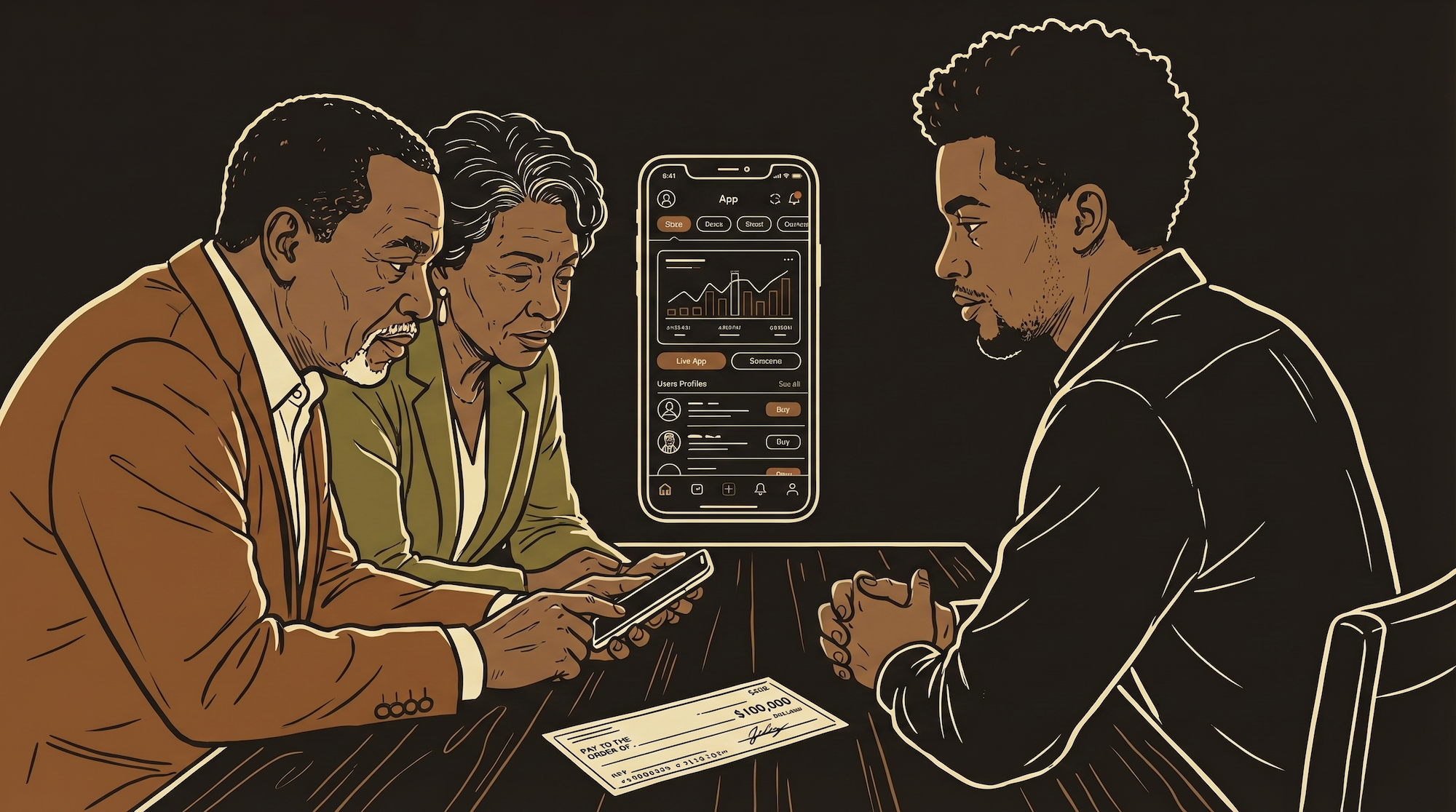
Fundraising is selling a percentage of your restaurant to someone who believes it will be worth more later. They give you money to build the kitchen. In exchange, they own a piece of every future dollar. The question is always: how much of the restaurant do you give away, and at what price?
First Question: Should You Even Raise?
Not every product needs outside money. Some are better off without it.
Raise When
Your product works but needs capital to grow faster than revenue allows. You have validated demand but cannot scale on cash flow alone. Your market has a timing window — competitors are raising and moving fast. You need to hire or invest in infrastructure that pays off over months, not weeks. You want access to investor networks and credibility for enterprise sales or partnerships.
Bootstrap When
Your costs are low enough to cover from personal savings or early revenue. Your market does not have a timing pressure — the opportunity will still exist in 12 months. You value complete control and do not want reporting obligations. Your product generates revenue early and can fund its own growth. You want to keep 100% of the upside.
There is no wrong answer here — only tradeoffs. Bootstrapping is slower but you own everything. Raising is faster but you give up a piece forever. The worst outcome is raising money you do not need, because you take on obligations without gaining meaningful acceleration. The second worst is not raising when you should have, because you miss a market window or burn out funding growth from personal savings.
For most solo AI founders: build first, raise second. Get your product working with real users before you talk to investors. A working product with 10 paying users puts you ahead of 90% of pre-seed pitches that are still at the idea stage.
The Funding Stages
Each stage has different expectations, different check sizes, and different investors.
| Stage | Typical Raise | What Investors Expect | Common Instrument |
|---|---|---|---|
| Pre-Seed | $50K-$500K | A prototype, maybe early users. They are betting on you and the market. | SAFE (post-money cap) |
| Seed | $500K-$3M | Product-market fit signals. Users who come back. Revenue or clear path to it. | SAFE or priced round |
| Series A | $3M-$15M | Proven unit economics. Repeatable growth. Clear use of funds for scaling. | Priced equity round |
| Series B+ | $15M+ | Scaling a proven model. Expanding markets, hiring teams, international growth. | Priced equity round |
Most solo AI founders start at pre-seed. The bar is lower — investors are backing your judgment and your ability to execute with AI leverage. A working product, even with 10 users, puts you ahead of 90% of pre-seed pitches.
Angels vs VCs
Who you take money from matters as much as how much.
Angel Investors
Individuals writing $5K-$100K checks from personal wealth. Often former founders or executives. Faster decisions — sometimes one meeting. Less formal diligence. They invest in people they believe in. Best for pre-seed. Downside: smaller checks mean you need more of them, and managing 15 angel relationships takes real time.
Venture Capital Firms
Funds writing $250K-$10M+ checks from pooled investor money. Partner meetings, formal diligence, term sheets. They invest in markets and business models. Best for seed and beyond. Upside: larger checks, brand credibility, follow-on capital. Downside: longer process, higher bar, may want board seats and control provisions.
Equity, Dilution & the Cap Table
Every dollar you raise costs you a piece of your company. Understand the math.
Ownership of your company, measured in shares. At formation, you own 100%. Every time you give shares to investors, employees, or advisors, your percentage goes down. The shares still exist — you just own a smaller slice of a (hopefully) bigger pie.
When your ownership percentage decreases because new shares are created for investors. If you own 100% and raise money at a $3M post-money cap by selling 10%, you now own 90%. Raise again at Series A and sell another 20%, you own 72% (90% x 80%). Each round dilutes your percentage — but if the company is worth more each time, your smaller slice is worth more dollars.
A spreadsheet showing who owns what. Every shareholder, every share count, every percentage. After your pre-seed, it might show: Founder 90%, Angel investors 10%. After seed: Founder 72%, Angels 8%, Seed VC 20%. The cap table is the single most important financial document in your company. Keep it clean from day one.
The SAFE — How Early Rounds Work
The standard instrument for pre-seed and seed. Simple, fast, founder-friendly.
A SAFE (Simple Agreement for Future Equity) is an IOU for ownership. The investor gives you money today. When you raise a bigger round later, their money converts into shares at a price you agreed on now — the valuation cap. No interest. No repayment deadline. No board seat. Y Combinator publishes the standard SAFE document for free.
The key number is the post-money valuation cap. If an investor puts in $300K on a $3M post-money cap, they will own 10% when the SAFE converts ($300K / $3M). A lower cap means more ownership for the investor. A higher cap means less dilution for you. This is the main negotiation point.
SAFEs are standard at pre-seed and common at seed. They are fast — a SAFE can close in days, versus weeks or months for a priced round. At Series A and beyond, investors typically want priced rounds with more formal terms, board seats, and governance rights.
Finding the Right Investors
Most founders waste months pitching the wrong people. Target precisely.
Alumni networks are your best warm intro. If you went to a university or worked at a company with an alumni investment community, start there. These investors already have a reason to take your call — shared background creates trust faster than a cold pitch ever will. Many large firms and consulting companies have alumni angel groups specifically for this purpose.
Angel groups and syndicates pool capital from multiple angels. One pitch to the group can result in multiple checks. Look for groups that focus on your sector (AI, edtech, consumer, etc.) rather than generalist groups. Sector-focused investors understand your market, ask better questions, and make faster decisions.
Cold outreach works if you have a working product. Investors ignore 95% of cold emails. The 5% they respond to have one thing in common: proof. "I built this product alone, it has 50 paying users, and here is a 2-minute demo video" gets responses. "I have an idea for an AI product and would love to chat" does not.
Build in public. Post your progress on social media. Share what you are learning. Investors follow builders. When you eventually reach out, they have already seen your work. "I have been following your progress — happy to chat" is the best investor email you will ever receive, and it comes from consistent public building, not from pitching.
The Pitch — What to Show, What to Say
Concise. Data-backed. Never over-claim.
The Problem (1 minute)
What is broken? Who experiences it? How big is the pain? Use a specific, concrete example. "120 million Americans want to learn a language. They spend $1,200/year on tutors who are available 2 hours a week. The other 166 hours, they have no one to practice with."
The Solution (2 minutes)
What did you build? Demo the live product. Not slides with screenshots — the actual product, working, on your phone or laptop. Investors see hundreds of decks. They rarely see a solo founder demo a live product with real users. That is your edge. Show it.
The Market (1 minute)
How big is this opportunity? Use real numbers from credible sources. Do not inflate — investors check. "The global language learning market is $XX billion" from a published report carries more weight than "we estimate the TAM at $XX billion" from your spreadsheet.
Unit Economics (2 minutes)
What does it cost to serve one user? What do you charge? What is your gross margin? What is your break-even subscriber count? Investors want to know the business works at the unit level before they care about scale. If one user is profitable, 10,000 users is a matter of distribution. If one user is unprofitable, 10,000 users is a faster way to go broke.
The Ask (30 seconds)
"We are raising $300K on a SAFE at a $3M post-money cap. The funds cover 12 months of runway — infrastructure, content production, and marketing to reach 500 subscribers." Be specific. Vague asks ("we need some capital to grow") signal you have not done the math.
Why You (1 minute)
Why are you the right person to build this? Domain expertise, unique insight, relevant experience. For solo AI founders: "I built this entire product alone using AI tools. That means my team of one operates at the efficiency of a team of ten, and my burn rate reflects that." This is a genuine competitive advantage. Name it explicitly.
Numbers You Must Know Cold
Hesitation on any of these signals you have not done the math.
How much are you raising?        "$[amount] on a SAFE."
On what terms?                  "$[X]M post-money cap."
What does that imply?           "[Y]% at the cap."
Monthly burn?                   "$[personal] + $[infra]."
Runway from the raise?         "[N] months."
Cost to serve one user?        "~$[X]/mo at mid tier."
Users to break even?           "[N] paying subscribers."
Current users?                 "[N] total, [N] paying."
Growth rate?                    "[N]% month over month."
// If you have to look any of these up, practice until you don't.
Common Rejections — What They Actually Mean
Investors rarely tell you the real reason. Learn to decode the polite ones.
| What They Say | What They Often Mean | What to Do |
|---|---|---|
| "It's too early for us" | They need more traction before they are comfortable with the risk | Get more users. Come back with numbers. |
| "We love it but want to see more data" | They are interested but not enough to commit now. Soft pass. | Set a specific follow-up date with a specific metric they want to see. |
| "Not the right fit for our fund" | Genuine. Their thesis does not include your sector, stage, or geography. | Ask who they would recommend. This is often a genuine referral opportunity. |
| "We have concerns about the solo founder risk" | They worry you will burn out, get stuck, or cannot scale leadership | Show your operating system. Demonstrate how one person operates as ten with AI leverage. |
| Radio silence after a great meeting | They are not interested but do not want to say no explicitly | Send one follow-up after 1 week. If no response, move on. Do not chase. |
Rejections are data, not verdicts. Pattern-match across multiple rejections to find the real blocker.
The Legal Foundation — Before Your First Investor Meeting
Handle these before any money changes hands.
Delaware C-Corp
Non-negotiable for venture fundraising. LLCs do not work for equity investors. SAFEs are designed around C-Corp share structures. Stripe Atlas or Clerky sets this up for ~$500 in about a week. If you already have an LLC, you will need to either convert it or dissolve it and reform as a C-Corp.
Founder Shares + 83(b)
Issue yourself 10M shares at $0.0001 par value. File your 83(b) election with the IRS within 30 days — miss this and you owe taxes on unrealized gains later. This is a one-time, irreversible deadline. Your incorporation service will walk you through it but you must actively complete it.
Legal Docs
Terms of Service, Privacy Policy, and if your product uses AI, specific disclosures about AI-generated content and data usage. Investors will ask. Users need them before you charge money. These are not optional — they are legal requirements that protect both you and your users.
Delaware charges franchise tax based on either share count or assumed par value. If you issue 10M shares and use the default calculation method, your tax bill could be tens of thousands of dollars. Always use the assumed par value method. This catches almost every first-time founder. Your accountant or incorporation service will guide you, but you need to know this trap exists before it surprises you.
The Tradeoffs — Bootstrapping vs Raising
Neither is inherently better. Both have real costs you cannot undo.
Bootstrapping
You own 100%. Every dollar of profit is yours. No investor meetings, no board updates, no dilution, no reporting obligations. But: slower growth, personal financial risk, no safety net if you run out of money, and no access to investor networks. Works best when your costs are low and your revenue starts early.
Raising Capital
You get runway — months or years of freedom to build without revenue pressure. Access to investor networks, credibility with potential partners and enterprise customers, and follow-on capital when you need to scale. But: you give up equity permanently, you have obligations to investors, and the expectation shifts from "build a profitable business" to "build a fundable business." Those are not always the same thing.

A working product is worth more than any pitch deck. Investors see hundreds of decks. They rarely see a solo founder demo a live product with real users. That is your edge. Use it.
Build first, raise second. Get your product working with real users before you talk to investors. Then walk in with a demo, not a deck. Your operating system — one person doing the work of ten — is itself a fundraising asset. Name it explicitly.